Bring the practice into context
The service offering, client language, voice, priorities, and operating guidance give each workflow a useful starting point.
REBOOT is a four-week company implementation for a small group of senior consultants or subject-matter experts. They learn a new way to work with AI, build live workflows around recurring practice work, and leave a foundation the wider practice can use and extend.
REBOOT starts with people who understand how the business runs, what clients need, what AI can automate, and where human judgment must remain.
They establish the foundation, build the first workflows, and take responsibility for what the wider practice can later use and extend.
The service offering, client language, voice, priorities, and operating guidance give each workflow a useful starting point.
Participants decide where AI should contribute, where human review belongs, and how to turn recurring practice work into a repeatable workflow.
The starting group runs and improves the workflows so other consultants can begin from a working foundation.
The Work OS is the practical system your people use around recurring desktop work in Claude Cowork or ChatGPT Work.
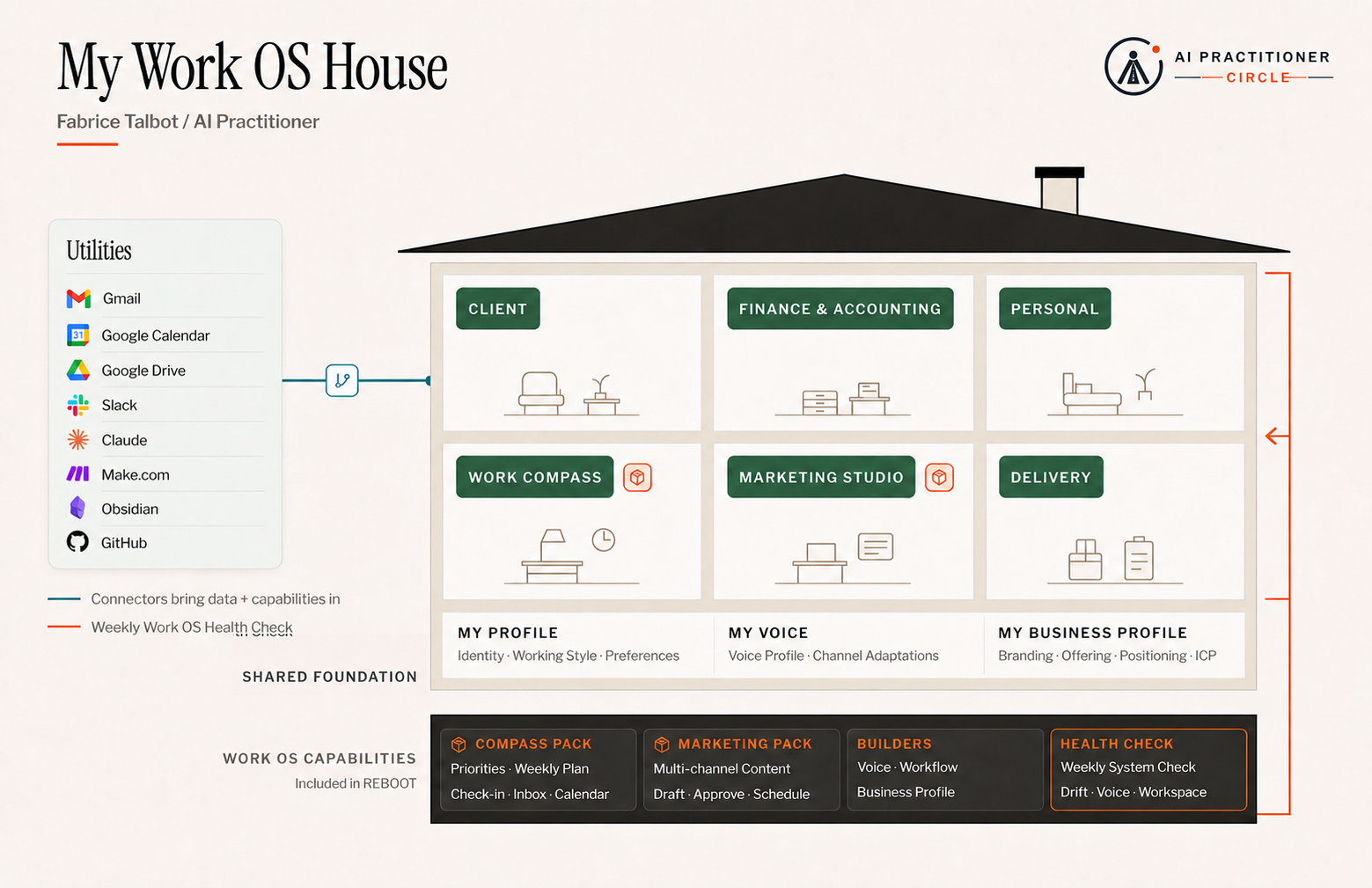
The Work OS brings context into the job, so participants can build and maintain useful workflows.
Client profiles, service offering, voice, terminology, priorities, and operating guidance give recurring work a common starting point. Workspaces organize the context, workflows, requests, outputs, and review points for a defined practice area.
Work Compass, Client Engagement Pack, and Content Studio provide starting points for recurring operating, client, and communication work. Context Builder, Workspace Builder, and Workflow Builder help participants create and maintain the workspaces and workflows their practice needs.
Health Check surfaces stale context, incomplete work, unresolved decisions, and workflow drift so the team can decide what needs attention.
REBOOT gives participants time to apply AI to real work, see where it breaks down, and improve the approach through practice.
Participants apply AI to their own client, project, content, and operational work while the implementation is underway.
The baseline commitment is one focused hour each weekday, with more time creating room to build, test, and improve the workflows that matter to the practice.
Participants return to the work each week, receive feedback, and improve the system through repeated practice.
The practice builds week by week. Each week gives participants time to apply and improve a new part of the Work OS in their real work.
Create the shared business context, calibrate voice and writing, install Work Compass, and establish the daily and weekly operating rhythm.
Apply the Client Engagement Pack to recurring work such as discovery, requirements, recommendations, proposals, and client communication.
Configure workspaces, adapt Packs, and use the Builders to create workflows around priority practice work such as client work, proposals, project communication, internal operations, or content.
Participants run their workflows against real or representative work, define review points and ownership, and prepare to show the working results to the practice.
I stay involved throughout implementation. I bring operating experience, relevant examples, and an AI Practitioner’s lens.
Each week includes a two-hour live session. Participants show what they built and ran. I make recommendations, demonstrate relevant techniques, and correct weak approaches.
Each participant submits work every week for personal review. I identify where the approach is breaking down, give specific feedback, and help unlock the next step.
The team has a dedicated Slack channel for questions, troubleshooting, and work-in-progress discussion between sessions. I respond within 24 hours, usually sooner, with slower replies on weekends.
By the end of REBOOT, your AI Practitioners are running live workflows in real work, with a shared foundation the business can use as more people begin.
Senior consultants who work with AI inside the business, improve the workflows they own, and help others adopt them.
Those same business details are available when people do repeatable work, so they do not rebuild the same context from scratch.
Client Engagement, Content Studio, and company-specific workflows run on real or representative work, with explicit review points and named ownership.
The business has a working foundation for adding more recurring work as priorities change.
Additional employees can begin using the shared context and workflows the AI Practitioners established, without repeating the full starting process.
The company receives a Work OS for internal use, with workflows and business context that can stay useful as the work changes. REBOOT also includes one year of access to the AI Practitioners Circle Community, Work OS updates, and new or updated Packs.
These are examples of practitioners using the Work OS around work they already own.

Before REBOOT, we used AI through one-off chats and still did the work manually. Now we use Bold&Zeal’s business context to generate a week of on-brand social content from one command, saving hours and freeing us to focus on client work, campaigns, and strategic priorities.
Erica Bazerkanian, CEO and Co-founder, Bold&Zeal

REBOOT gave us a working foundation for recurring business operations. We use AI to prepare staff schedules from availability, run a daily sales report from Square, and support our Instagram work. Scheduling now takes about 30 minutes instead of four to six hours, giving the business a clearer process to build on.
Benoit Vialle, Owner, Maison Benoit
NEXT STEP
Tell me about the recurring work your team wants to improve, the people who should be involved, and whether Work OS Blueprint or REBOOT is the right next step.